• Skip to primary navigation
  • Skip to main content
  • Skip to primary sidebar
  • Internet
    • Browsers
    • Cloud Computing
    • Online Video
    • Search Engines
    • Web 2.0
  • Mobile
    • Android Apps
    • Apps
  • Software
  • Funny Stuff
  • Social Networks
  • Web Tools

Daily Bits

  • Home
  • About
  • Archives
  • Contact
  • Advertise

Internet

We Are Now Posting 50 Million Tweets Daily

May 2, 2023 by Arnold Zafra

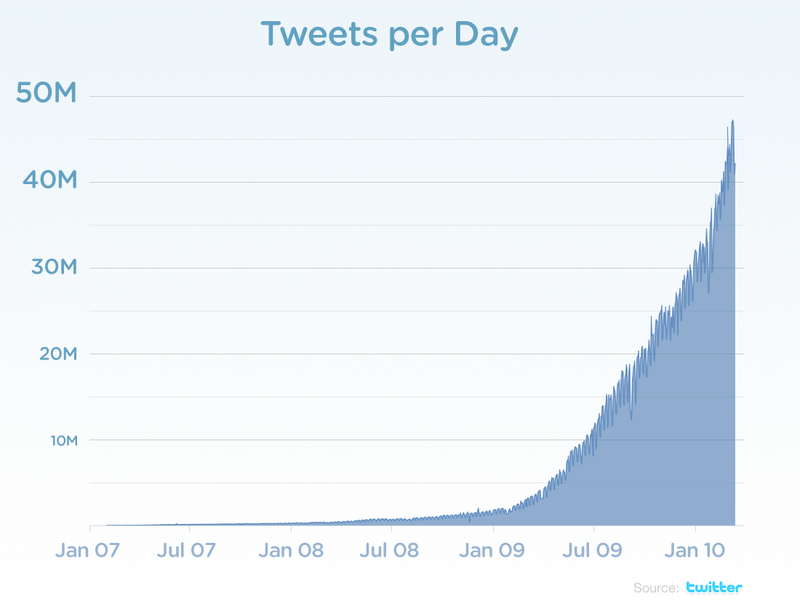
Funny how a short post on the Twitter blog could spark an online discussion that even led to the long-standing Twitter vs. Facebook war.  Yesterday, a post on the Twitter blog announced that we, Twitter users are now sending 50 million tweets into the Twitter-sphere everyday. Now, how’s that for another issues that says Twitter is not growing?

But anyway, yes Twitter has just grown to 50 million tweets a day. Up from 5,000 times a day in 2007, 300,000 in 2008 and 2.5 million in 2009. Right now, it’s at a 50 million per day or 600 tweets per second. If you won’t call that exponential growth, I have no idea what else you can call this phenomenon.

And that doesn’t include spammy tweets. Twitter has removed tweets from accounts that were identified as spam.

Now, the issue that were raised by some analyst is whether Facebook has all the reason to be afraid of Twitter’s growth. Facebook updates were last reported at 60 million per day.  That means that Twitter is fast catching up. But that is in terms of daily updates. When it comes to total number of users and even monthly page views – Twitter is still far inferior to Facebook.

I really think that there is no point of comparison here and we should all try to pause for awhile and rethink how we view Twitter vis-a-vis Facebook. I’m more inclined to think that Twitter compliments Facebook. Facebook is more of a social networking site while Twitter is more of a real-time online communication tool.

But then, who am I to change this predominant mindset, anyway?
Filed Under: Internet, Social Networks Tagged With: facebook, tweets, Twitter, Twitter Updates

Profiling Americans Who Are Least Likely to Go Online

May 2, 2023 by Arnold Zafra

Hot on the heels of carrying out its plans of providing high-speed Internet access to Americans, the FCC has just released an interesting report providing the profile of users who are least likely to adopt broadband subscriptions.

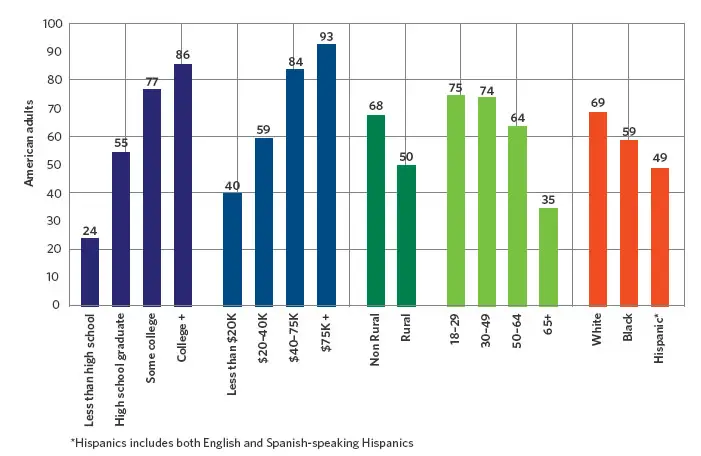
The report categorizes these users as either digitally distant, digital hopefuls, digitally uncomfortable and new converts. According to the report 20% of Americans are digitally distant and digitally uncomfortable.

Digitally distant users are described as those who are retired and say that they don’t subscribe to broadband either because they don’t know how to use a PC or don’t see a need to use the Internet at home or anywhere else. Around 10% of the American population falls into this category, and include those whose ages ranges from 63 and older.

Digitally uncomfortable Americans on the other hand are those who can afford high-speed Internet service but would rather not subscribe to because they lack the skills to use it. Around 7% of  Americans fall into this category.

The other two categories of U.S. population are the so called digital hopefuls and the Near Converts. Digital hopefuls are those who like to subscribe to broadband Internet but don’t have the money to pay for fees. They make up around 8% of the American population.

And then you have the Near Converts comprised of Americans  who are mostly dial-up users who are still thinking whether they would pay $40 for broadband Internet access. They make up 10% of the American population.

So, to which category do you see yourself belonging to? Are you currently subscribe to a broadband Internet access or if not, are you planning to subscribe to in the near future?

You can check out the full FCC report here.

Filed Under: Internet, Media Tagged With: broadband internet, internet users

Online Image Editor Aviary Joins the Free App Crowd

May 2, 2023 by Arnold Zafra

I first learned about Aviary a couple of months ago, back then  I could only try out some of its features and wished that its other advanced features were free that time. A couple of months after, here’s Aviary finally setting its powerful suite of browser-based design tools free for anyone to use.

To set things straight this early, Aviary is not just online image editor. Like I said it’s a suite of web applications made specifically for creative people who want to create stuff and do more with their photos and creations.

Three key features of Aviary which has been added since it is now a free online app include:

  • saving private files
  • automatic addition of watermark
  • access to all the tutorials on how to effectively use Aviary’s suite of creation tools

If you’ve used Aviary before and actually  signed up for a paid  subscription in the alst 30 days, here’s a good news – Aviary will refund your payments.

As a creation tool, Aviary offers you six editing tools represented by various bird species. These include:

Phonenix – the main image editing tools such as layers, masks, effects, undo history and more.

Peacock – Aviary’s visual laboratory or the effects editing tools.

Raven – the vector editor.

Falcon – the image markup tool which you can use to capture images and web pages from your browser or desktop and crop, resize or mark them up.

Myna – audio editor which you can use to remix music tracks and audio clips as well as for applying sound effects and record your own voice or instruments.

Toucan – Aviary’s color palette that you can use in conjunction with other creation tools. It also lets you inject color into your creation.

Ready to exercise your creative talents? Check out the free Aviary tools now.

Filed Under: Internet, Web Tools Tagged With: aviary, image editor, online apps

Mobile Phone is the New Social Connector

May 2, 2023 by Arnold Zafra

Ruder Finn, an independent PR company published some interesting findings of their new study – Mobile Intent Index. The study measures, well mobile phone users’  intent for accessing the Internet via their mobile devices.

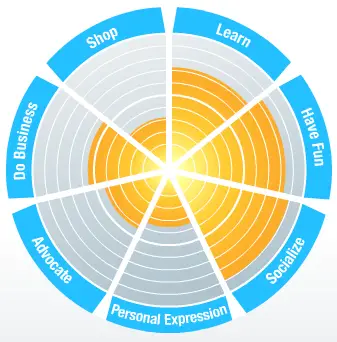
According to the report, the average time spent by Americans on the mobile Internet is 2.7 hours. And what do they do during those times?  To socialize, manage their personal finances and push their advocacy.

Contrary to what we may have believed all along, mobile phone users do not access the Internet via mobile phones for educational purposes or for creative expression.  The study also found out that usage by gender and age differ. That is men access the mobile web to “escape” while women to “make others laugh.” Now that seems rather vague, right?

Another interesting finding of the report is the fact that immediacy is the major factor why users access the Internet via mobile.

“Our survey data shows that people use their mobile phones out of necessity for instant access to the Web whether it’s to conduct business with the most recent information or advocate on the spot on issues of pressing concern and breaking news,” said Marty McGough, director of Ruder Finn Insights

The study also highlights the fact that mobile phone apps are continously increasing with 61% of the respondents saying that they have downloaded an application at least once per month, and 36% of the respondents saying that they have downloaded applications from social networking sites at least once per month.

As a mobile connector, mobile phone access is used primarily to:

  • Instant message – 62%
  • Forward e-mails (58%), content (40%) and photos (38%)
  • Post comments on social networking sites – 45%
  • Connect to people on social networking sites – 43%

Interesting findings, right? So, which of these connectivity features do you do on your mobile phone?

Filed Under: Internet, Mobile Tagged With: mobile internet, mobile phones

BuddyPress Now Available for All WordPress Installation

May 1, 2023 by Arnold Zafra

BuddyPress, a social networking add-on that previously worked only with WordPress MU installation is now available for all WordPress installs.  I’m really excited about this development as I’ve always wanted to try out BuddyPress for a long time now.

With BuddyPress 1.2 on your standard WordPress install, you can now start letting your blog readers create extended profiles, display activity streams, discussion forums, private messaging and groups within individual posts on your blogs.  What’s good about BuddyPress 1.2 is the fact that you can turn off some of its features which you don’t like to have.

Integrating WordPress on your current blog installs is easily done as well. It only takes three steps which you can follow here. After installing, you  may need to tweak it a bit to work well with your blog’s overall theme.

In addition to the features we mentioned BuddyPress also now includes permalinks for each action in the activity streams. Likewise, users will now be able to “favorite” activity items as well as send @replies to other users. Truly, a powerful social networking feature.

For requirements, you need to have at least WordPress 2.9.1 or better yet upgrade your install to 2.9.2 if you haven’t done so yet.

Filed Under: Internet, Software Tagged With: buddypress, wordpress

Social Network Users are Predominantly Young Middle-Aged Folks

May 1, 2023 by Arnold Zafra

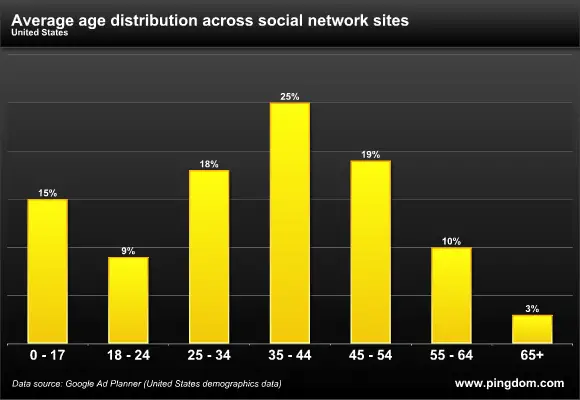
First of, I really have to commend the folks at Royal Pingdom for coming up with such a comprehensive study on the demographics of social network users. It’s a pretty good study with just about enough statistics that will really give you a good grasp of who are really into social networking today. So, what do they find out? Majority of the social network users are predominantly middle-aged folks who belong to the 35-44, not that tech savvy youngsters that we may all have thought before this study.

The study took stock of site demographics information for the United States which they gathered using Google’s Ad Planner service and then made additional calculations to come up with their final data. The report includes age data of members from 19  social networking sites including -Facebook, MySpace, LinkedIn, Twitter, Reddit, Digg, Slashdot, Delicious, StumbleUpon, Friendster, Last.fm, Friendfeed, LiveJournal, Hi5, Tagged, Ning, Xanga, Classmates.com and Bebo.

So, some interesting highlights of the report include:

  • 25% of social network users belong to the 35-44 age group
  • 3% of social network users belong to the 65-older group
  • 65% of the users are in using Twitter and/or Facebook
  • Bebo and MySpace are both widely used by users age 17 or younger

Those were just some of the key findings of the report. If you want to learn more, just check out Royal Pingdom.

Meanwhile, what really puzzles me is the fact that if  the predominant users of Facebook are age 35-44 how come I still see tons of Mafia updates, senseless trivia questions, virtual gifts and other utterly unimportant stuff from my Facebook contacts?  Does this mean that Facebook users are into the site not for business and social networking purposes but rather to while away time?  Where is the maturity there, friends?

Filed Under: Internet, Social Networks Tagged With: Social Networks, user demographics

  • « Go to Previous Page
  • Page 1
  • Interim pages omitted …
  • Page 18
  • Page 19
  • Page 20
  • Page 21
  • Page 22
  • Interim pages omitted …
  • Page 55
  • Go to Next Page »

Primary Sidebar

Privacy Policy

Copyright © 2025 · News Pro On Genesis Framework · WordPress · Log in