• Skip to primary navigation
  • Skip to main content
  • Skip to primary sidebar
  • Internet
    • Browsers
    • Cloud Computing
    • Online Video
    • Search Engines
    • Web 2.0
  • Mobile
    • Android Apps
    • Apps
  • Software
  • Funny Stuff
  • Social Networks
  • Web Tools

Daily Bits

  • Home
  • About
  • Archives
  • Contact
  • Advertise

General

FIFA: Goal-Line Technology Just Might Be Needed

May 30, 2023 by noemi

You think? That’s how most football (or soccer, if you want) fans are reacting to FIFA’s new stand on using video technology to assist in officiating World Cup games. This change of heart is really not surprising given the recent turn of events in several matches during this year’s World Cup.

Who can forget Saturday’s match between England and Mexico? Both teams were victims of mistakes made by the referees. Not to mention another England match, this time against Germany. The point is moot now, as the games have gone on, and teams have been eliminated. While we cannot put all the blame on the referees for the demise of some teams (yeah, I am thinking about England as I write), we also cannot deny the fact that if FIFA were using video technology as part of the rules of the game, then the outcome might just be a tad different.

It is not a revolutionary thing, really. The NBA is already using it. The NFL has provisions for video review as well. So what’s holding FIFA up?

With public pressure mounting, there doesn’t seem to be any reason for this technology not to be implemented in the near future. FIFA president Sepp Blatter has already issued public apologies to England and Mexico for the blatant mistakes. In his statement, he also mentioned something about considering goal-line technology for FIFA matches. Take note – that doesn’t cover everything, but at least it is a good start, isn’t it?

Here’s my question: do you think the solution is technology or, simply, better officiating?

Filed Under: General Tagged With: FIFA, football, goal-line technology, soccer, sports, video technology

Liquid Crystal Technology Offers Better Storage Option

May 28, 2023 by noemi

Storage is always a problem for us, isn’t it? Remember the days when all we had were hard disks with a few megabytes of storage? The days when we marveled at the floppy discs? It is amazing how technology has evolved in the past decades, really. Now, we have hard drives that can contain up to terabytes of data. How cool is that? Even flash disks can contain gigabytes of information!

Of course, it seems that in this area, we just can’t get enough – both in quality and quantity. And, if a group of researchers in Tokyo are fully successful, we just might see another generation of storage devices.

Eureka Alert just featured the work of Hideo Takezoe and his team of researchers. Apparently, they have been working on liquid crystal technology – the same technology being currently used in televisions and computer monitors. Who would have thought that they could have made progress in using this technology for data storage?

How does it work?

The group of researchers has taken advantage of a property of liquid crystals called anchoring transition. In simple terms, this property can be used to write, erase, and rewrite data by using laser beams. The liquid crystal molecules, which are rod-like in nature, are aligned by the application of these laser beams. The result? Rewritable data storage!

Even better, the liquid crystals are bi-stable, meaning that the orientation is retained in one of two directions. The practical implication is that the storage material does not need power to retain images. Imagine the potential of this technology!

Filed Under: General Tagged With: data storage, hardware, LCD, liquid crystals

Microsoft “Kinect” Unveiled

May 26, 2023 by noemi

You might know it by another name – Project Natal – but Microsoft’s new hands-free motion control system has now been announced to the public. Its new name is Kinect, and is supposed to change the way we play games forever.

I seriously don’t know what to think of the names – Project Natal wasn’t great to begin with, and I just don’t think Kinect is better (although I see the kinection connection…)

Anyway, the details of Kinect have been – finally – shared with us, courtesy of BBC:

Kinect was shown off at a glitzy event alongside compatible games, which support the new hands-free interface and, in some cases, the facial and voice recognition capabilities.

These ranged from jumping and flying games to a yoga simulator and Star Wars shooter, in which players control a virtual light sabre and use hand gestures to control action on the screen.

There was also a virtual pet, which can be controlled and played with using Kinect. Microsoft says it will release the full details of its games at another media event on 14 June.

The official unveiling was supposed to be during the E3 expo, but I guess Microsoft wanted to pre-empt its competitors. After all, Sony and Nintendo are pretty much ahead of Microsoft in this arena.

So when are we going to see this new thing in the market? They say by the end of the year, but who really knows?

Filed Under: Games, General Tagged With: gaming, Kinect, microsoft, video games, Xbox

Are You Happy with Facebook’s New and Simpler Privacy Controls?

May 24, 2023 by Arnold Zafra

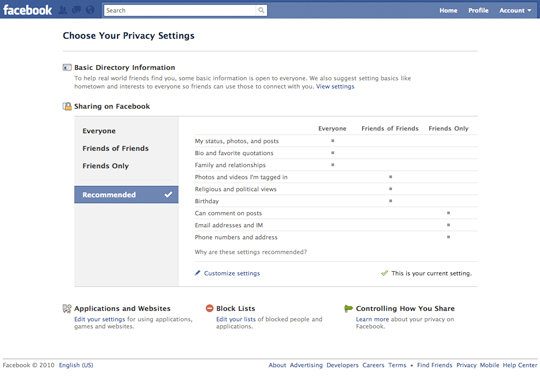
Here’s could probably be Facebook’s last ditch effort at convincing everyone of us that it minds user privacy. And this could possibly make or break Facebook, either retaining loyal users to driving them away to other “more secured” social networking sites.

So as Facebook is confronted with issues about its “complex” privacy policy, it now announces a simpler privacy control measures via a long post on the Official Facebook blog. But essentially, there are three major issues addressed by Facebook’s new privacy controls.

First thing which Facebook did was to build one simple control for setting who can see content that you post. You can now specify whether the content is viewable by everyone, friends of your friends or just by your friends. Which ever settings you choose will be applied to new products which Facebook will introduce in the future.  You don’t need to set them up once new products are introduced.

Then Facebook also reduced the amount of basic information that are visible to everyone. The connections privacy model was also removed. You now have the ability to control who can see your friends and pages and those information are no longer default to public. Of course, as these are basic information, it is but logical to have these for public viewing since its the only way for other people to find you. Otherwise, there’s no point in maintaining your Facebook account anymore.

Finally, Facebook also made it simpler to control how apps and websites access any of your information. Turning this off is now easier and can be easily done via a simple click. Turning off instant personalization is also easier now and gives you the facility to allow only partner sites to see things you’ve made visible to everyone.

With that, Facebook is proud to announced that its privacy model is now complete. And it hopes that issues concerning user privacy would be finally put to a rest.

These new privacy controls will be rolled out to everyone in the next few weeks. By then, we will know whether users are satisfied with the measures and make them stay with Facebook.

Filed Under: General, Internet, Social Networks Tagged With: facebook privacy

Browsers Leave “Fingerprints” as You Surf the Web

May 23, 2023 by Arnold Zafra

Common now folks. Is it really possible that as web browse and leave a website, that we might be leaving “fingerprints” behind, enough for hackers to track us as we surf the web? Well, according to the latest research conducted by Electronic Frontiers Foundation, web browsers have digital signatures that create fingerprints that can be used your web browsing habit.

EFF conducted an experiment whereby volunteers were asked to visit the site http://panopticlick.eff.org. This site apparently logged users’ browser configurations and version information anonymously. Information were gathered by the site from user’s OS, browser and browser plug-ins.  EFF’s study revealed that 84% of the configuration combinations were unique and identifiable that leads to the creation of idenfiable browser “fingerprints.”

EFF also found out that there are some browsers which we less likely to contain unique configurations, especially those which blocks JavaScript. Likewise, some browser plug-ins can also be configured to limit the information that your browser shares to the websites you visit.  Unfortunately thought, in general it’s very hard to reconfigure your browser to make your identify less identifiable. EFF suggest that new privacy protections should be built into the browsers themselves.

EFF Senior Staff Technologist Peter Eckersley tells us:

“Browser fingerprinting is a powerful technique, and fingerprints must be considered alongside cookies and IP addresses when we discuss web privacy and user trackability,” said Eckersley. “We hope that browser developers will work to reduce these privacy risks in future versions of their code.”

So, there. Let this serves as a warning for us to be cautious of what browsers we are using and make sure that these offers really offer privacy protection, like what they claim they do.

Filed Under: General Tagged With: web browsers, web secuirty

Study: Consumers are Willing to Pay for Content on E-Readers, iPad, Tablets

May 23, 2023 by Arnold Zafra

Call it a spark of genius from the part of Apple. But undoubtedly, the  iPad has certainly awaken an otherwise sleeping e-book and tablet market.According to a recent Boston Consulting Group Study which showed that more than half of surveyed consumers plan to buy an iPad, Kindle or similar device in the next three years. More important than that is the findings that these consumers appear willing to pay for content to be consumed on those devices.

The survey was conduced to nearly 13,000 consumers in 14 countries including India, China, Germany, United Kingdom and the United States. The study found out that 28% of these respondents and 51% of those familiar with this devices plan to purchase them within the next few year. In three years time, 49% of the respondents and 73% of those familiar with them are also planning on a purchase.

What do these figures tell us? Well, if these numbers are to push through, e-readers and tablets would soon established themselves as another category of consumer products in the likes of  TVs, PCs and mobile phones.

Another positive impact would be injecting fresh hope to the otherwise dying publishing industry.

John Rose, the global leader of BCG’s Media Practice said:

“The survey suggests that e-readers and tablets are not a niche product for early adopters but could become the MP3 players of this decade. Grandmothers will soon be carrying them around.”

There is one catch though. For e-readers and tablets, such as the Kindle and iPad to succeed in infiltrating the consumer market, a significant price drop should happen. Right now,  the Kindle, iPad and other tablets and e-readers are relatively priced similar to other established consumer electronics products. Considering that their features are limited as compared to a traditional computing machine, price should naturally be cheaper.

Hopefully, both the Amazon and Apple folks are reading this or would get hold of the BCG Report.

Filed Under: General

  • « Go to Previous Page
  • Page 1
  • Interim pages omitted …
  • Page 21
  • Page 22
  • Page 23
  • Page 24
  • Page 25
  • Interim pages omitted …
  • Page 116
  • Go to Next Page »

Primary Sidebar

Privacy Policy

Copyright © 2025 · News Pro On Genesis Framework · WordPress · Log in